From AI Adoption to AI Operationalization
Financial institutions have moved beyond experimenting with AI. The next challenge is operationalizing it across the enterprise.
Unlike traditional AI systems that respond to predefined instructions, Agentic AI can reason, plan, collaborate, and execute complex business workflows autonomously. This shift creates enormous opportunities to improve productivity, customer experience, and operational efficiency—but it also introduces new challenges around governance, trust, architecture, and organizational readiness.
Successfully operationalizing Agentic AI requires more than deploying new technology. It demands a holistic transformation across five critical dimensions: enterprise architecture, data, governance, workforce, and infrastructure.
This blueprint provides a practical framework to help financial institutions assess their readiness and build a scalable foundation for AI-First banking.
Key Takeaways
Five Things Every Banking Leader Should Know
- Agentic AI represents a shift from task automation to autonomous enterprise decision-making.
- AI readiness extends beyond technology and requires organizational transformation.
- Enterprise architecture must evolve to support intelligent orchestration across systems.
- Trust, governance, and explainability are essential for scaling AI in regulated industries.
- Banks that build strong AI foundations today will be better positioned to compete in an AI-First economy.
The Five Dimensions of Enterprise AI Readiness
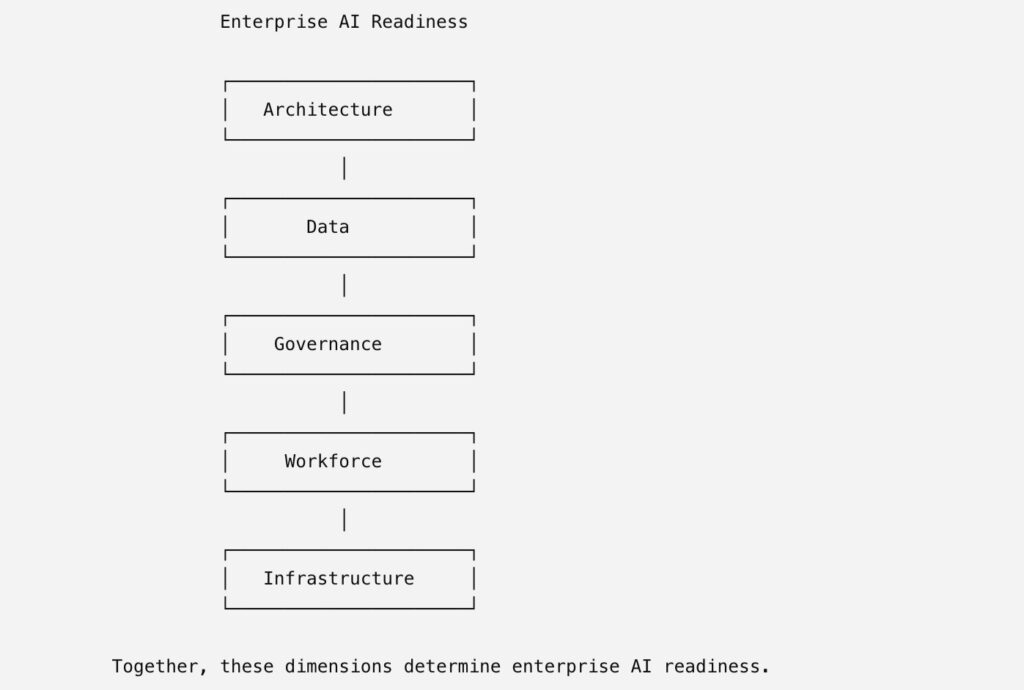
Operationalizing Agentic AI requires coordinated transformation across five interconnected dimensions. Weakness in any one area can limit the effectiveness, scalability, and governance of enterprise AI initiatives.
1. Architectural Readiness
Why It Matters
Agentic AI depends on interconnected enterprise systems capable of orchestrating intelligent workflows across business functions.
Key Challenges
- Legacy technology landscapes
- Fragmented applications
- Limited interoperability
- Siloed business processes
What Financial Institutions Need
- API-first architecture
- Composable platforms
- Intelligent orchestration
- Real-time connectivity
Business Outcome
A flexible architecture that enables AI agents to collaborate securely across enterprise systems.
2. Data Readiness
Why It Matters
AI is only as effective as the quality, accessibility, and context of the data it can understand.
Key Challenges
- Data silos
- Poor quality
- Limited context
- Inconsistent governance
What Financial Institutions Need
- Trusted enterprise data
- Knowledge graphs
- Financial ontologies
- Semantic enrichment
- Context-aware data models
Business Outcome
High-quality enterprise knowledge that enables AI agents to reason and act with confidence.
3. Governance Readiness
Why It Matters
Financial institutions require AI systems that are transparent, secure, explainable, and compliant.
Key Challenges
- Regulatory uncertainty
- Model risk
- Explainability
- Security
- Ethical AI
What Financial Institutions Need
- Responsible AI policies
- Explainable decision-making
- Human oversight
- Continuous monitoring
- Enterprise controls
Business Outcome
Trusted AI that satisfies regulatory expectations while enabling innovation.
4. Workforce Readiness
Why It Matters
AI transformation is as much about people as technology.
Key Challenges
- Skills gaps
- Organizational resistance
- New operating models
- Leadership alignment
What Financial Institutions Need
- AI literacy
- Cross-functional collaboration
- Human-AI workflows
- Continuous learning
Business Outcome
A workforce equipped to collaborate effectively with intelligent systems.
5. Infrastructure Readiness
Why It Matters
Enterprise AI requires resilient, scalable, and secure infrastructure.
Key Challenges
- Compute requirements
- Latency
- Scalability
- Security
- Operational resilience
What Financial Institutions Need
- Cloud-ready infrastructure
- GPU-enabled compute
- Secure deployment environments
- Observability
- High availability
Business Outcome
Infrastructure capable of supporting enterprise-scale AI workloads reliably and securely.
Conclusion
Building the Foundations for an AI-First Enterprise
Agentic AI represents the next evolution of enterprise transformation. But realizing its full potential requires more than deploying intelligent agents—it demands the right foundations across architecture, data, governance, workforce, and infrastructure.
Financial institutions that invest in these capabilities today will be better positioned to innovate with confidence, operate at scale, and compete successfully in an AI-First economy.
Whether you’re beginning your AI journey or expanding enterprise-wide adoption, operational readiness will determine long-term success.