By Prashant Lalchandani, CTO, Intellect Design Arena
I have been using LLMs almost daily for almost four years now. The models are becoming more intelligent with every release. They will draft the architecture, explain the regulation, write the code, and hand me a good answer in under a minute.
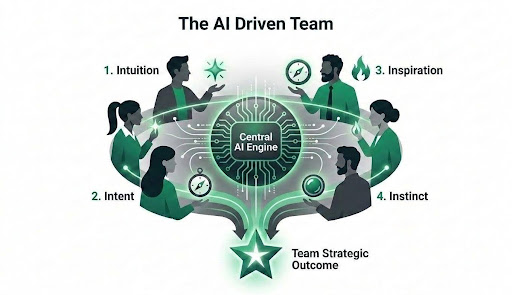
My learning is that Intelligence isn’t the only part of my job. Intelligence is the part I no longer have to supply. Four other things I still do: Intuition, Intent, Inspiration, and Instinct. Not a checklist. They show up in that order, at different points in the same piece of work.
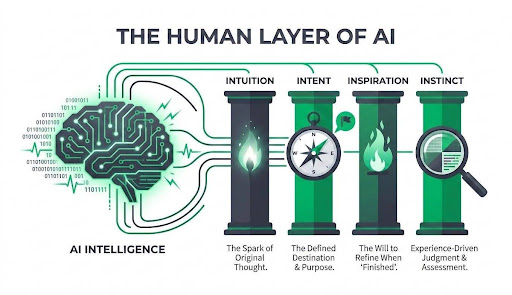
1. Intuition: where it starts
The best ideas about what needs to be done sometimes arrive when I am not looking for them. They come in the shower, or during meditation, when the mind is quiet and something surfaces on its own. Or they come sideways. I am looking at something in a completely unrelated context and start connecting dots that have no business being connected.
Not every one of those sparks is worth acting on, and sorting them is its own skill. But the spark is the beginning of everything, and no prompt produces it. Every conversation with an AI begins with a human who has decided that something deserves attention.
This becomes more important as the models improve, not less. When building gets cheap, knowing what to build is what is the differentiator
2. Intent: what we are solving for
If intuition is the seed, Intent is the destination.
In practice it means framing the problem properly and being clear about the questions I actually want answered. Get that wrong and you get excellent work pointed in the wrong direction, delivered very fast.
One practical observation: models like Opus do better when you hand them the intent rather than the approach. Tell it where you want to end up and it will often find a better path than the one you had in mind. Prescribe the path and you get exactly what you asked for, nothing more.
There is one more thing about intent. The model does not have to live with being wrong. I do. The accountability of the deliverable lies with me, not the model.
3. Inspiration: the will to keep going when AI thinks it is done
This is the one I feel most strongly about.
Every AI response ends. The model answers, and it is finished. It does not wake up at 2 am because the answer was fine but not right. Tell it the solution is good enough and it will agree with you and never return to it.
Here is what that looked like for us at Intellect.
For the past three years the industry has mostly told a single story about AI in software delivery: individual productivity. Developers write code faster. Analysts summarize faster. Testers generate cases faster. Almost every project I see being touted in the news and social media as success, measured the same thing, which is how much quicker one person is at one task. The numbers are good, really good. We could have stopped there and set that as the target, and plenty of people did.
We kept looking, but not at the tools. We went back and studied how projects actually get executed. How work packets get defined and closed. What happens at the handoff from one team member to the next and how that should change.
That is where it became clear. The individual gains were real, but project level gains needed focus on team productivity, not just individual productivity. So the question changed. Not how do we make each person faster, but how does AI work on the work itself: the packet, the handoff, the context that today sits in somebody’s head and gets lost in transit. Individual productivity to team productivity.
No model was ever going to tell us the win was too small. That had to come from us.
4. Instinct: knowing good from not-good
Then there is judgment. You read a narrative and you know whether it lands. You look at a design and you know it will not hold, before you can say why. The reasons usually catch up a day or two later.
It can be argued that intuition and instinct are similar faculties, but they arrive at different moments, so I treat them separately. Intuition comes unasked. Instinct fires when something is put in front of me.
It is not gut feel and it is not prejudice, though it is easy to mistake for both. It is the experience built over the years that has been compressed. Hundreds of similar situations whose outcomes I watched, condensed until only the signal remains and the individual cases are gone.
Which is also why it has limits. Instinct is worth trusting in the areas where you have actually seen how things turned out. Outside those areas it is a preference in a nice suit.
What this means in practice
None of this adds up to trusting your gut over the machine.
Instinct is not a veto, it is a flag. It tells me which of the hundred things in front of me deserves a hard look, and AI does the looking, at a depth and speed I cannot match. I decide where to point it.
I read somewhere that two roles will matter most in IT from here: knowing what to do, and having the system depth to solve the problem once AI has finished thinking. Those are the first and the last of my four. Intent and inspiration are what carry you between them.
Intelligence is no longer the job. Intuition, intent, inspiration and instinct are.